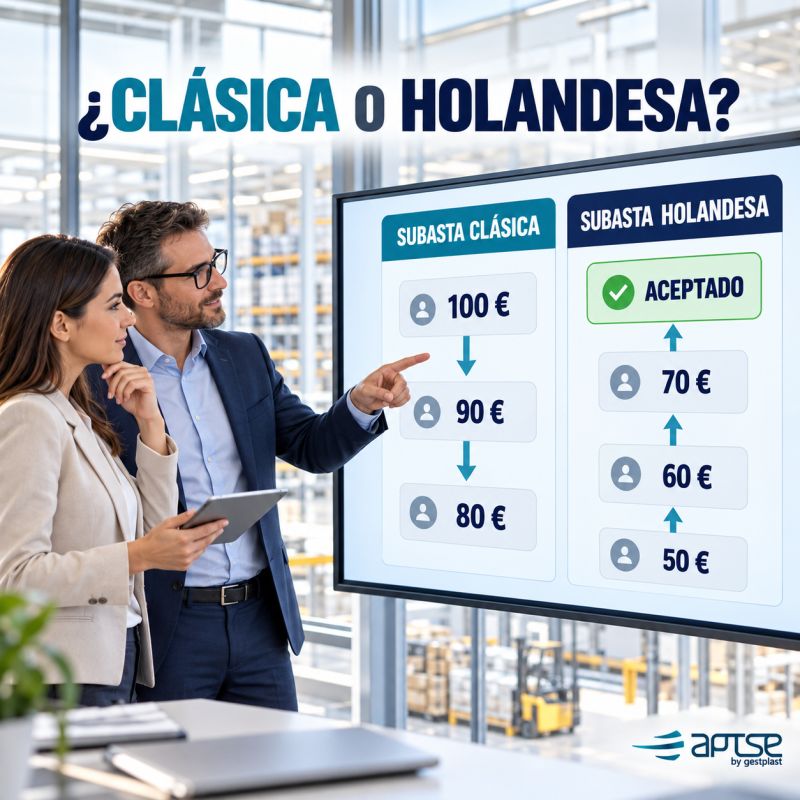
Choosing between an English or Dutch reverse auction requires an understanding of how suppliers enter the negotiation. Both formats allow competition between valid proposals, but their mechanics differ: in an English reverse auction, suppliers lower their bids; in a Dutch reverse auction, a low starting price rises until a participant accepts it.
The choice depends on the number of suppliers, the spread of their prices, the purchasing conditions and the negotiation strategy. An AGV procurement case shared by Gestplast illustrates this approach: three solutions validated during the RFQ and a Dutch reverse auction that closed at €26,400.
How an English reverse auction works
In a classic, or English, electronic reverse auction, suppliers submit increasingly competitive quotations during the defined bidding period. Each participant can revise its price under the event rules.
This format supports dynamic competition and may be suitable when several qualified suppliers are participating, initial quotations are relatively close and there is room for successive bids. These conditions help inform the choice, but they do not guarantee a particular level of savings.
What automatic extensions contribute
Extensions give participants time to respond to a bid received close to the deadline. For example, an event can be configured to extend by one minute if a bid arrives during the final minute.
The activation period, extension duration and maximum number of extensions need to be defined. The event closes according to those rules: an automatic extension does not mean that the auction can continue indefinitely.
How a Dutch reverse auction works
In a Dutch reverse auction for procurement, the price starts at a previously defined low amount and increases at set intervals. The first supplier to accept the amount stops the auction.
Each participant decides when the proposed price allows it to deliver the agreed scope. Waiting may bring a higher price, but another supplier may accept first.
This approach may be useful when technical proposals have already been validated, scopes are comparable and the quotations show a significant price spread. That spread needs analysis: it can also reveal differences in scope that must be resolved before negotiating.
This article concerns reverse auctions for purchasing. This distinction matters because the direction of price changes differs from a Dutch auction used for selling.
English or Dutch reverse auction: key differences
| Aspect | English reverse auction | Dutch reverse auction |
|---|---|---|
| Price movement | Suppliers improve their bids by lowering the price. | The set price increases at intervals until accepted. |
| Supplier action | Submit further bids during the event. | Decide when to accept the displayed amount. |
| Closing mechanism | The bidding period and configured extensions end. | A supplier accepts the price under the event rules. |
| Situation to consider | Close quotations and scope for successive improvements. | A wider price spread and a clear acceptance point. |
| Shared preparation | Valid, comparable proposals, eligible participants and clear rules. | |
A real example: negotiating an AGV purchase
In the process described by Gestplast, all three AGV solutions had been validated during the RFQ. Their quotations were:
- First quotation: €39,648.
- Second quotation: €45,879.60.
- Third quotation: €55,458.
The team chose a Dutch reverse auction for the negotiation. The accepted price was €26,400, compared with €39,648 for the best valid quotation obtained during the RFQ.
| Measure | Result |
|---|---|
| Best valid RFQ quotation | €39,648 |
| Accepted auction price | €26,400 |
| Price reduction | €13,248 |
| Percentage reduction | 33.41% |
The €13,248 difference is calculated by subtracting the two amounts. The percentage uses the best valid RFQ quotation as its baseline, rather than the highest quotation. It is the outcome of this specific process, not a forecast for other purchases.
What to check before selecting a format
1. Validate suppliers’ ability to deliver
An auction format cannot resolve a lack of capacity or technical non-compliance. Review requirements, quantities, delivery dates and terms before inviting suppliers to compete. Our guide to preparing an electronic auction explains these checks.
2. Understand why quotations differ
Before interpreting price differences as negotiating room, check that the proposals cover the same scope. If exclusions or missing information remain, further RFQ rounds may be needed to clarify and align quotations.
3. Design and explain the rules
Define the schedule, price steps and participation conditions. For an English reverse auction, specify bidding and extension rules; for a Dutch reverse auction, define the starting price, increments and intervals. Suppliers should understand the mechanics before the event.
4. Separate the price outcome from the final decision
Establish negotiation and supplier selection criteria in advance. Interpret the auction result alongside technical, commercial and service validations, together with the approvals required for the purchase.
Frequently asked questions
Does a Dutch reverse auction always achieve a larger reduction?
No. The result depends on the purchasing conditions, competition and preparation. The AGV case illustrates one application; it does not demonstrate that the format is always superior.
Is a large price spread enough to choose a Dutch reverse auction?
No. First confirm that the quotations are comparable. Then assess the spread together with the number of participants and the project’s negotiation strategy.
Can one project use different auction formats?
Yes. For example, the six-lot metal parts project published on our blog combined English and Dutch reverse auctions. Each lot may need its own assessment.
Prepare your negotiation with APTSE
APTSE’s electronic auction software supports both formats. Our team can help prepare, configure and manage the process, taking account of the quotations received and the purchasing requirements.
If you are considering which format to use for your next negotiation, contact APTSE and request a demonstration.