An RFQ, or Request for Quotation, is a formal request that a company sends to one or more suppliers to obtain and compare prices and commercial terms for a specific product or service.
An RFQ is normally used when the purchasing company has already defined what it needs and wants suppliers to submit comparable quotations. The process allows the buyer to evaluate pricing, delivery times, payment terms and other relevant conditions before selecting a supplier.
An RFQ is not simply an email asking several companies how much a product costs. A properly structured process defines what is being purchased, the conditions suppliers must follow, the information they must provide and how their quotations will be evaluated.
APTSE defines an RFQ as a request used to identify different pricing options for a particular product or service, especially when the company knows exactly what it needs.
What does RFQ mean?
RFQ stands for Request for Quotation.
It may also be referred to as a request for quote, quotation request or request for pricing. In a B2B purchasing process, the buyer sends the RFQ and the suppliers respond by submitting their quotations.
An RFQ can ask suppliers to provide information such as:
- Unit and total prices.
- Volume discounts.
- Delivery times.
- Payment terms.
- Transport costs.
- Quotation validity.
- Warranties.
- Additional services.
- Compliance with technical specifications.
The RFQ is therefore the request issued by the buyer, while the quotation is the supplier’s response.
Although price usually plays an important role in the decision, it does not have to be the only criterion. A lower-priced quotation may be less attractive if it includes longer delivery times, unfavorable payment conditions, higher logistics costs or an insufficient level of service.
When should you use an RFQ?
An RFQ is particularly useful when the company already knows the essential characteristics of the product or service it needs and wants to compare the conditions offered by different suppliers.
For example, an RFQ may be appropriate when the following elements have already been defined:
- Technical specifications.
- Required quantities or estimated volumes.
- Place of delivery or service provision.
- Quality requirements.
- Project schedule.
- Minimum supplier requirements.
In these circumstances, the company does not need each supplier to design a completely different solution. Instead, all participants respond to the same requirements, allowing the purchasing team to compare their quotations objectively.
An RFQ can be used for:
- A one-off purchase.
- A recurring supply agreement.
- The renewal of an existing contract.
- The identification of alternative sources of supply.
- The comparison of existing and potential suppliers.
- A new negotiation involving several qualified suppliers.
An RFQ is less suitable when the company has not yet determined which solution it needs, which technologies are available or which suppliers can meet its requirements.
In those situations, it may be more appropriate to begin with an RFI, or Request for Information, before moving on to an RFQ.
How does an RFQ process work?
Although every company can adapt the process to its internal procedures, an RFQ normally involves the following stages.
1. Define the purchasing requirement
The first step is to determine exactly what the company needs to purchase.
The purchasing team usually works with the requesting department to define:
- Technical characteristics.
- Quantities.
- Delivery dates.
- Delivery locations.
- Service conditions.
- Quality standards.
- Mandatory supplier requirements.
If the requirement is not clearly defined, each supplier may interpret it differently and prepare its quotation using different assumptions. This makes the responses difficult to compare.
2. Prepare the RFQ
Once the requirement has been defined, the buyer prepares the RFQ document or digital template that suppliers will receive.
The RFQ should clearly structure the information being requested and establish a common format for all responses. When every participant uses the same template, it becomes much easier to compare prices, cost items, delivery periods and commercial conditions.
APTSE allows purchasing teams to create detailed cost-breakdown templates so that each component of the supplier quotations can be analyzed separately.
3. Select the suppliers

The company then determines which suppliers are qualified to participate.
These may include:
- Approved suppliers.
- Existing business partners.
- Previous bidders.
- New suppliers identified through market research.
- Suppliers evaluated through an earlier RFI.
There is no universal number of participants that applies to every RFQ. The objective is to invite enough qualified suppliers to obtain a representative comparison without involving companies that cannot realistically meet the requirements.
In APTSE, each RFQ project is only accessible to suppliers invited by the project administrator.
4. Send the request
All invited suppliers should receive the same information, documentation and response deadline.
Questions may arise concerning the specifications, volumes, delivery conditions or rules of the process. Centralizing these questions and communications helps prevent some suppliers from receiving information that is not available to the other participants.
The buyer should also define:
- The deadline for submitting questions.
- The final quotation deadline.
- The expected decision date.
- The contact channel.
- The documents that must be submitted.
5. Receive supplier quotations
Suppliers prepare and submit their quotations according to the requested structure.
In addition to prices, they may provide:
- Technical documentation.
- Certifications.
- Production schedules.
- Commercial observations.
- Alternative proposals.
- Warranty conditions.
- References.
- Supporting files.
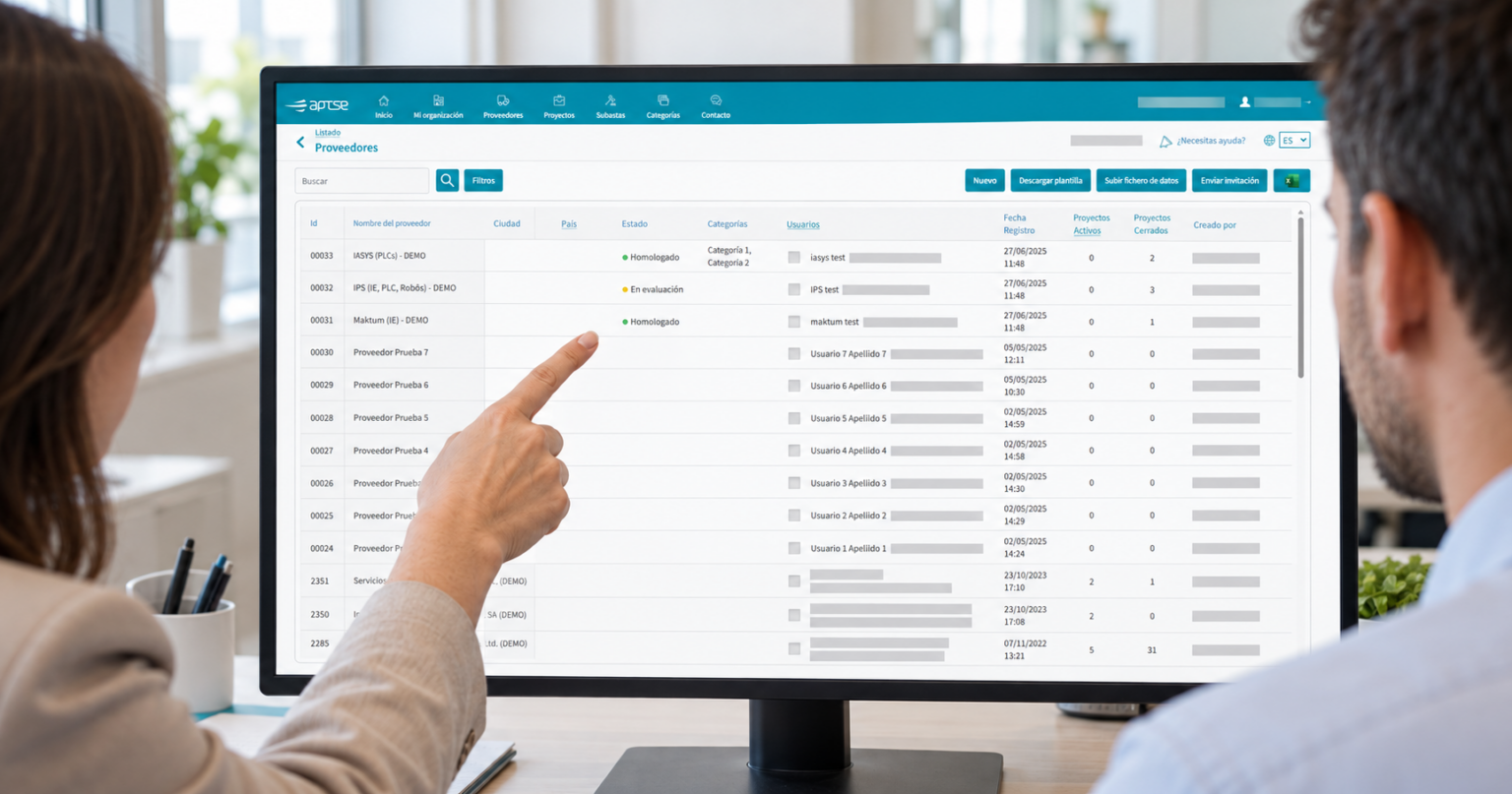
A digital platform allows the administrator to check which suppliers have viewed the request, accepted the invitation and submitted a quotation.
APTSE also provides a private area where suppliers can upload documents confidentially and share them with the project administrator.
6. Compare and evaluate the quotations

The purchasing team reviews the responses and verifies whether each quotation meets the mandatory requirements.
Before comparing prices, it may be necessary to normalize the information. For example, suppliers may have used different:
- Units of measurement.
- Transport assumptions.
- Packaging arrangements.
- Currencies.
- Warranty periods.
- Payment conditions.
- Pricing structures.
The evaluation should consider all criteria that are relevant to the purchase, including:
- Technical compliance.
- Total cost.
- Production capacity.
- Delivery time.
- Payment terms.
- Warranty.
- Quality.
- Logistics risks.
- After-sales service.
- Supplier reliability.
The cheapest quotation does not necessarily represent the best overall purchasing decision.
7. Negotiate and award the contract
After analyzing the quotations, the company may:
- Select the most suitable supplier.
- Request clarification.
- Ask suppliers to revise their quotations.
- Open another bidding round.
- Begin a direct negotiation.
- Launch an electronic auction.
When the technical proposals are comparable and there is sufficient competition, the RFQ can be used as the basis for a subsequent electronic auction.
The selected quotation may then lead to a purchase order, supply agreement or commercial contract.
What information should an RFQ include?
A clear RFQ should provide suppliers with enough information to prepare a complete and comparable quotation.
The precise content will depend on the purchasing category, but an RFQ should normally contain the following sections.
Purpose of the request
Provide a brief explanation of what the company wants to purchase and the objective of the process.
Suppliers should understand the general context without having to interpret the buyer’s requirements themselves.
Product or service specifications
Include all relevant technical characteristics, materials, dimensions, quality levels, service scope and mandatory requirements.
Where necessary, attach:
- Technical drawings.
- Product specifications.
- Service descriptions.
- Quality documentation.
- Photographs.
- Plans.
- Standards and certifications.
Quantities and volumes
Indicate the number of units, estimated annual consumption, expected order frequency or volume bands.
When exact quantities are not yet available, explain whether the figures are forecasts, estimates or non-binding volumes.
Delivery conditions
Specify:
- Delivery dates.
- Delivery locations.
- Supply frequency.
- Packaging requirements.
- Transport conditions.
- Incoterms, where applicable.
- Installation or commissioning requirements.
Pricing structure
Define how suppliers must present their prices.
The RFQ may request:
- Unit price.
- Total price.
- Volume discounts.
- Transport costs.
- Initial investments.
- Tooling costs.
- Maintenance costs.
- Installation costs.
- Additional fees.
Requesting a cost breakdown provides greater transparency and makes it easier to identify the factors causing differences between supplier quotations.
Commercial conditions
State the required or proposed commercial conditions, including:
- Payment method.
- Payment period.
- Currency.
- Quotation validity.
- Warranty.
- Contract duration.
- Penalties.
- Renewal conditions.
- Pricing review mechanisms.
Required documentation
List all files and evidence that suppliers must submit, such as:
- Technical data sheets.
- Certificates.
- Drawings.
- Samples.
- References.
- Insurance documents.
- Quality documentation.
- Supplier approval documents.
Evaluation criteria
Suppliers should understand which aspects will be considered and which requirements are mandatory.
The buyer does not necessarily need to disclose the exact weighting of every criterion, but the process should clearly distinguish between mandatory requirements and factors that will influence the final decision.
Process schedule
Specify the key dates, including:
- Publication or invitation date.
- Deadline for questions.
- Deadline for submitting quotations.
- Clarification period.
- Expected decision date.
- Estimated contract start date.
Practical RFQ examples
The following hypothetical examples show how an RFQ can be used in different purchasing categories.
Example 1: purchasing industrial components
A manufacturing company needs to contract the annual supply of 25,000 machined components.
The RFQ could include:
- Technical drawings and tolerances.
- Required material.
- Annual volume.
- Estimated monthly demand.
- Delivery location.
- Quality requirements.
- Pricing by volume band.
- Tooling costs.
- Production lead time.
- Transport conditions.
- Payment terms.
When the responses follow the same structure, the purchasing team can compare not only the price of each component but also tooling costs, production capacity, delivery times and logistics expenses.
Example 2: contracting a maintenance service
A company wants to contract preventive maintenance services for three production sites.
The RFQ could specify:
- Facilities covered.
- Number of annual inspections.
- Maximum response time.
- Service hours.
- Personnel qualifications.
- Fixed maintenance fee.
- Rates for additional interventions.
- Travel costs.
- Materials included.
- Contract duration.
In this case, price should be evaluated together with service coverage, response times, technical capability and supplier experience.
Example 3: purchasing industrial machinery
A manufacturing company wants to purchase a new machine for one of its production lines.
The RFQ could request:
- Compliance with technical specifications.
- Equipment price.
- Transport.
- Installation.
- Commissioning.
- Operator training.
- Manufacturing lead time.
- Warranty.
- Maintenance.
- Recommended spare parts.
- Energy consumption.
If the company has not yet determined which technology or machine configuration it needs, an RFI or RFP may be more appropriate before issuing the RFQ.
RFQ, RFI and RFP: key differences
RFQs form part of the group of purchasing processes commonly referred to as RFx.
RFx is a general term covering different types of requests that a company can send to potential suppliers.
RFI: Request for Information
An RFI is used to gather information about suppliers, their capabilities and the solutions available in the market.
It is normally carried out before the purchasing requirement has been fully defined.
An RFI helps the company:
- Understand the supplier market.
- Identify available technologies.
- Discover potential suppliers.
- Compare capabilities.
- Refine its requirements.
- Prepare a future RFQ or RFP.
RFP: Request for Proposal
An RFP asks suppliers to propose a solution to a business requirement.
It is useful when the methodology, technical approach or proposed solution is an important part of the evaluation.
In an RFP, suppliers may submit significantly different solutions, and price is not necessarily the main evaluation criterion.
RFQ: Request for Quotation
An RFQ asks suppliers to provide prices and commercial conditions for a more clearly defined requirement.
It allows the buyer to compare quotations using a common structure.
In simple terms:
- An RFI asks: What options and suppliers are available?
- An RFP asks: What solution do you propose?
- An RFQ asks: At what price and under what conditions can you supply it?
Common mistakes when preparing an RFQ
A poorly prepared RFQ can result in incomplete quotations, delays and a more difficult negotiation.
The following are some of the most common mistakes.
Failing to define the requirement clearly
When the specifications are ambiguous, suppliers calculate their prices using different assumptions.
The buyer then receives quotations that cannot be compared directly.
Requesting only a total price
A single total amount does not explain which cost components are responsible for the differences between suppliers.
A detailed cost breakdown provides greater transparency and supports more effective negotiation.
Allowing suppliers to use different formats
When every supplier responds using its own spreadsheet, document or quotation template, the purchasing team must spend time transferring and normalizing the information.
A standardized response format makes the comparison faster and more reliable.
Changing the conditions for individual participants
Any relevant clarification or change should be communicated consistently to all suppliers affected by the process.
Otherwise, the quotations may have been prepared using different information.
Evaluating only the price
The cheapest quotation may not offer the best overall result when quality, delivery, additional costs, payment terms and supply risks are considered.
Managing the entire process through separate emails
Duplicated files, outdated versions and dispersed conversations make the process difficult to trace and increase the amount of administrative work.
Centralized management helps ensure that the purchasing team and suppliers are working with the correct information.
Benefits of managing RFQs on a digital platform

Many companies still prepare RFQs in Excel, send them by email and consolidate supplier responses manually.
This approach may be sufficient for a simple purchase involving a small number of suppliers. However, difficulties begin to appear as the number of participants, users, items, documents or delivery locations increases.
An online RFQ platform allows the company to centralize the entire process:
- Create the RFQ and its templates.
- Invite selected suppliers.
- Share relevant files.
- Manage questions and communications.
- Receive quotations in a common format.
- Compare supplier responses.
- Maintain a complete process record.
- Prepare the negotiation and award decision.
APTSE digitizes the RFQ process from initial creation to the final comparison of supplier quotations.
The platform allows purchasing teams to:
- Create cost-breakdown templates.
- Invite selected suppliers.
- Exchange documents confidentially.
- Centralize communications.
- Monitor supplier participation.
- Compare responses.
- Maintain process traceability.
- Prepare a subsequent negotiation or electronic auction.
APTSE is also compatible with Excel, allowing companies to import and export templates and reports while maintaining a centralized and traceable purchasing process.
Digitize your requests for quotation with APTSE
A well-structured RFQ helps companies obtain comparable quotations, improve transparency and make purchasing decisions using more complete information.
With the APTSE RFQ module, you can centralize your requests for quotation, invite selected suppliers, exchange documentation, manage communications and analyze proposals from a single SaaS platform.
APTSE was developed by Gestplast Ingeniería Consulting using its experience in purchasing project management, RFx processes and supplier negotiations.
Request a personalized demonstration or try APTSE free for seven days.
Frequently asked questions about RFQs
What does RFQ stand for?
RFQ stands for Request for Quotation.
It may also be described as a request for quote or quotation request.
What is an RFQ used for?
An RFQ is used to request and compare the prices and commercial terms that different suppliers offer for a particular product or service.
When should an RFQ be used?
An RFQ should be used when the company has already defined its purchasing requirement and wants to compare commercial proposals from several suppliers.
Can an RFQ be used to contract services?
Yes. An RFQ can be used both for purchasing physical products and for contracting services.
What is the difference between an RFQ and a quotation?
The RFQ is the request sent by the buyer. The quotation is the response submitted by the supplier.
Does an RFQ require the buyer to select the cheapest supplier?
No. The company can evaluate other factors such as quality, delivery times, service, warranty, payment terms and total cost.
What happens after quotations are received?
The buyer analyzes the responses, requests clarification where necessary and then selects a supplier, opens another negotiation round or uses the quotations as the basis for an electronic auction.