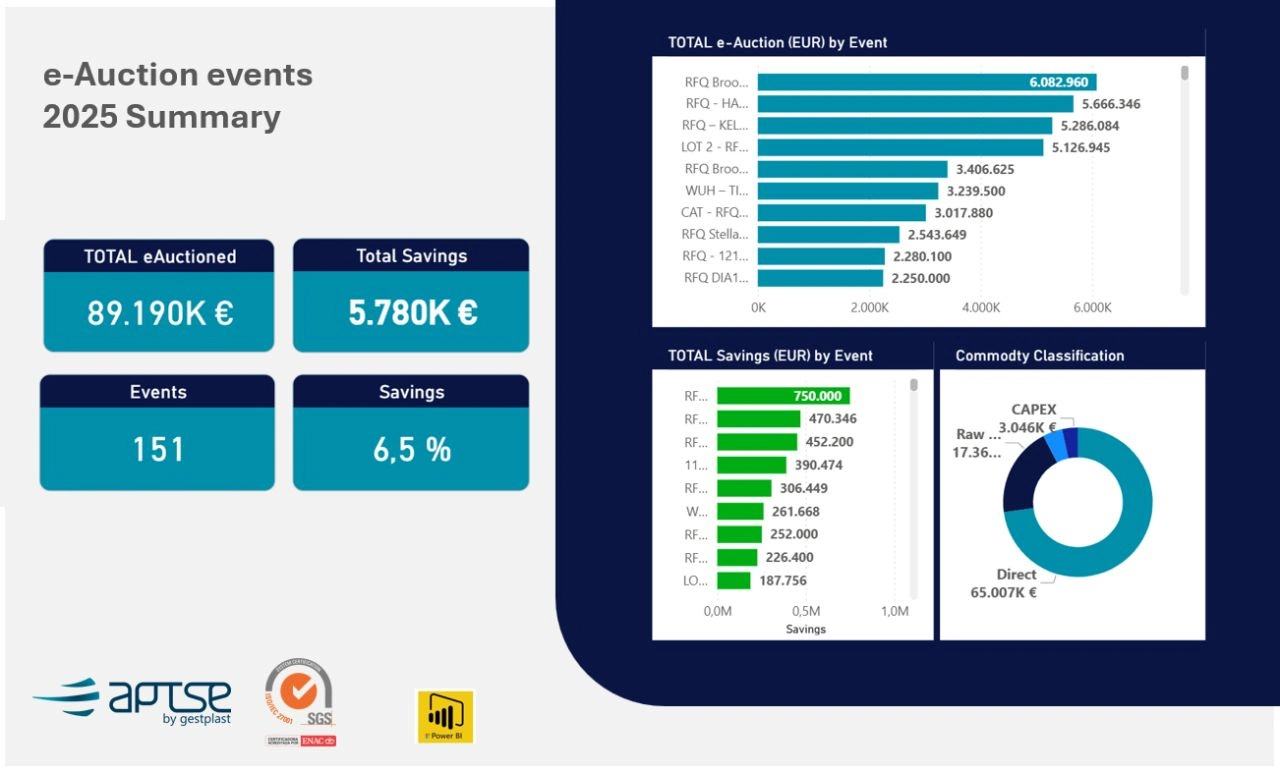
In 2025, Gestplast’s teams managed 151 electronic auction events covering €89.19 million in procurement value, with total reported savings of €5.78 million. The annual summary puts aggregate savings at approximately 6.5% of the value managed.
These figures provide an overview of the year’s negotiation activity. They show both the scale of the processes managed and their financial results, extending beyond an individual transaction.
This article reviews the main figures in the annual summary and explains how procurement teams can interpret them.
Electronic Auction Results in 2025
The “e-Auction events — 2025 Summary” report presents the following indicators:
| Indicator | Result |
|---|---|
| Electronic auction events | 151 |
| Total procurement value managed | €89,190,000 |
| Total reported savings | €5,780,000 |
| Aggregate savings as a share of the value managed | Approximately 6.5% |
Source: Gestplast’s published summary of electronic auction events in 2025.
The value managed shows the scale of the activity: €89.19 million in purchases negotiated through electronic auctions.
The €5.78 million figure represents the savings recorded in the annual summary. It is the combined result reported for the events included in the document.
What Does the 6.5% Aggregate Savings Figure Mean?
The relationship between reported savings and total procurement value is:
€5,780,000 ÷ €89,190,000 × 100 ≈ 6.48%
Rounded to one decimal place, this gives the 6.5% shown in the report.
This indicator expresses savings relative to the value managed. It is not a simple average of the savings percentages achieved in each event: larger purchases carry a different weight in the overall result.
Nor does it mean that every auction achieved savings of 6.5%. Each negotiation depends on its starting conditions, the purchase requirements, the participating suppliers and the competitive dynamics.
The figures are presented as reported in the published summary. The document does not specify the baseline used to calculate savings for each transaction, so they are not attributed to a particular comparison with budgets, historical prices or previous quotations.
151 Events: An Overview of the Year’s Activity
The number of events helps put the financial result into context. The summary covers 151 auction events, providing a broader view of annual activity than an individual case study.
It is important to distinguish between events and projects. A purchase can be divided into several lots and involve multiple auctions. The number of events should therefore not be interpreted as the number of clients or independent projects.
This distinction is also useful when planning procurement activity. A negotiation may cover an entire purchase, a product family or a single lot within a larger project.
Different Purchase Values and Contributions to Savings
The report’s charts show differences in both the values negotiated and the savings recorded across events.
This makes it useful to assess each transaction from two perspectives:
- Percentage savings, which express the improvement against the baseline used.
- Savings in euros, which show the financial contribution to the overall result.
A moderate percentage reduction on a large purchase can generate a substantial amount of savings. Equally, a high percentage improvement on a smaller purchase may have a more limited financial impact.
Both measures should be considered together when assessing procurement results.
A Range of Procurement Categories
The report’s classification chart includes direct purchases, raw materials and CAPEX, meaning capital expenditure on assets.
This provides context for the range of purchases covered by the summary. Preparing a negotiation requires consideration of each category’s characteristics, including specifications, quality requirements, supply capacity, lead times and commercial terms.
The aggregate result provides an annual overview. Analysis by category and event helps explain more precisely where improvements are achieved.
A Practical Example: Six Lots of Metal Parts
To understand how negotiations can be organised by lot, see the published case study on metal parts electronic auctions that delivered €403,000 in savings.
In that project, APTSE managed six auctions: three classic reverse auctions and three Dutch reverse auctions. Participation ranged from three to nine suppliers per lot, with different savings percentages achieved in each negotiation.
The case illustrates why it is useful to examine both the overall result and the details of each lot. Within a single purchase, values, competition and opportunities for improvement can vary.
The annual summary and individual case studies provide complementary information: the former shows the scale of activity, while the latter explain how specific negotiations are carried out.
What Should You Prepare Before an Electronic Auction?
The 2025 results provide a record of the activity completed. To apply this negotiation approach to a new purchase, the first step is to assess whether the right conditions are in place.
Define a Comparable Scope
Participants need to understand what is being purchased and under which conditions. Specifications, quantities, lead times, transport and acceptance requirements must be sufficiently clear to allow bids to be compared.
If suppliers are pricing different scopes, a price comparison can be misleading.
Select Suppliers That Can Meet the Requirements
Before negotiating, check that candidates can meet the technical and supply requirements.
Price competition should take place between viable alternatives. An attractive price needs to be supported by suitable capacity, quality and delivery conditions.
Establish the Negotiation Rules
Participants should understand how the event works, how long it will run and which conditions apply.
The auction format and configuration should reflect the characteristics of the purchase and the objectives of the negotiation.
Define How Results Will Be Measured
To assess a transaction, document the financial baseline in advance and maintain a comparable scope.
Relevant costs and conditions should also be recorded. This makes the result easier to explain and avoids confusing a price reduction with a change in quantities, specifications or responsibilities.
These checks help make the subsequent analysis useful to Procurement and the wider organisation.
Monitoring and Visibility of Negotiations
Alongside the financial results, Gestplast’s publication highlights real-time competition, the recording of bids and data analysis as elements of the digital process.
Having access to the data from each negotiation makes it easier to review its progress, compare results and communicate the procurement team’s activity.
The annual summary itself illustrates this benefit: it brings together event numbers, procurement value, savings and purchase categories in a single view.
The publication also describes operational benefits relating to speed and time savings. However, the summary does not quantify these effects, so the measured results presented here focus on financial and activity indicators.
What This Summary Contributes to a Procurement Strategy
The 151 events and €5.78 million in reported savings provide a concrete reference for the results recorded in 2025.
For a company considering electronic auctions, the next step is to identify which purchases could benefit from this approach. A useful starting point is to look for purchases with clearly defined requirements and suppliers capable of competing on a common basis.
The potential of each transaction should be assessed individually. Historical results provide evidence of experience, while the objectives of a new negotiation should be set according to its own conditions.
Apply Electronic Auctions to Your Procurement Processes
With APTSE, you can manage negotiations through our SaaS platform or work with our team to organise your electronic auctions.
To explore which purchases could suit this approach, contact our team to discuss your project or request an APTSE demonstration.