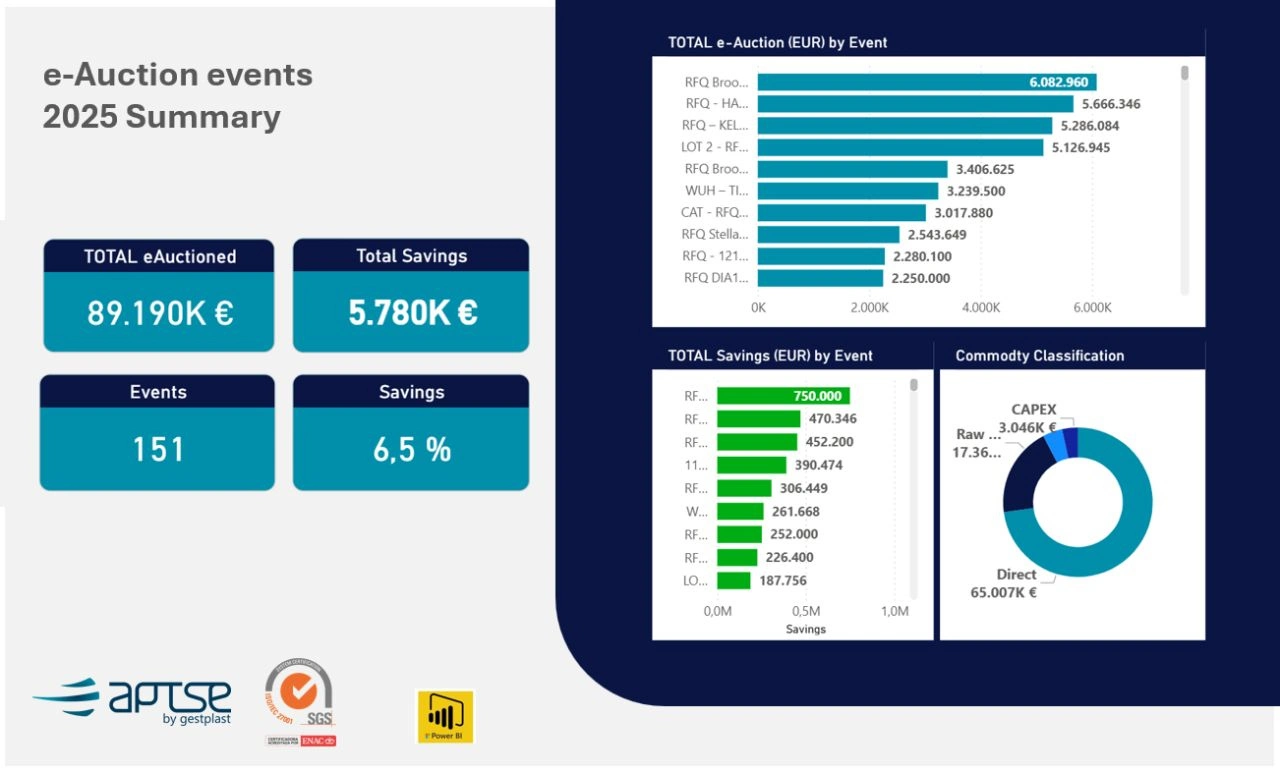
An electronic auction, also known as an e-auction, is a negotiation process carried out through a digital platform in which several participants can submit and improve their bids according to a set of predefined rules.
In business procurement, this type of negotiation allows previously selected suppliers to compete in real time for a business opportunity. Depending on the objective of the process, bids may move downwards —as typically happens in a reverse auction for procurement— or upwards when a company uses the auction to sell an asset, material or other resource.
Technology makes it possible to manage key aspects of the process in a structured way, including participants, starting prices, duration, bids, automatic extensions and the information each supplier can view during the negotiation.
However, an electronic auction does not replace a sound procurement strategy. To achieve a successful outcome, the company must first define what is being negotiated, which suppliers are qualified to participate and under what conditions their proposals will be compared.
What is an electronic auction?
An electronic auction or e-auction is a competitive negotiation conducted online over a defined period of time.
Participants access a digital environment and submit bids according to the conditions established by the company organizing the process. During the auction, they can improve their proposals depending on the auction format and the information made available to them.
APTSE provides dedicated electronic auction software for businesses that enables companies to configure and manage these negotiations within a private digital environment accessible only to invited suppliers.
Compared with a traditional negotiation based on successive phone calls, emails or meetings, all participants compete within the same structured process and under the same predefined rules.
What is the difference between a traditional auction and a reverse auction?
The direction in which the price moves depends mainly on whether the company is looking to buy or sell.
Auction for selling
In a traditional auction, a company offers an asset, material or other item and several buyers compete to acquire it.
In general, the price increases as participants improve their bids. The seller’s objective is to achieve the best possible commercial conditions.
APTSE has used this approach, for example, in an electronic auction for the sale of metal scrap in the Netherlands. Four companies participated in the process and the sale price increased from €209,945.38 before the auction to €266,804.69, representing an improvement of 27.08%.
Reverse auction for procurement
In a reverse auction, the logic is reversed.
The buying company presents a requirement and suppliers compete to win the business by improving their offers.
When price is the variable being negotiated, bids normally move downwards: suppliers progressively reduce their prices in an attempt to remain competitive.
This model is particularly suitable when several qualified suppliers can provide a sufficiently well-defined product or service and their proposals can be compared on an equivalent basis.
APTSE, for example, managed a reverse e-auction for a waste gas treatment machine in which three suppliers submitted 63 bids during a 55-minute session. The negotiation reduced the best pre-auction quotation by 27.49%.
How does an electronic auction work?
Although the exact configuration depends on each project, a professional electronic auction can usually be divided into several stages.
1. Define what is being negotiated
Before organizing an auction, the company must clearly define the product, service, asset or purchasing category involved.
In a procurement process, this may include:
- Technical specifications.
- Quantities.
- Delivery locations.
- Delivery schedules.
- Payment terms.
- Quality requirements.
- Warranties.
- Logistics costs.
- Contract duration.
Suppliers need to know exactly what they are bidding on.
An auction should not be used to resolve technical differences through price when the underlying requirements have not yet been clarified.
2. Select the participants
The next step is to identify which companies are suitable to participate.
In a procurement auction, the objective is not simply to invite as many suppliers as possible. The important point is that participants have already been evaluated and are capable of meeting the requirements of the project.
Participants may include incumbent suppliers, previously qualified companies or new candidates identified during the sourcing process.
When the market is not yet sufficiently understood, an RFI can be carried out first to gather information, assess supplier capabilities and identify suitable candidates.
The APTSE RFI software allows companies to structure questionnaires, centralize supplier information and compare responses before moving to the commercial stage of the process.
3. Obtain and compare initial quotations
Before starting the negotiation, it is useful to have information that establishes the suppliers’ initial commercial positions.
An RFQ can be used to request prices and commercial terms using a common structure.
This stage helps Procurement verify that proposals are genuinely comparable and identify differences relating to transport, specifications, delivery times, warranties or other conditions.
We explain this process in greater detail in What Is an RFQ? Meaning, Process and Examples.
RFQs and electronic auctions are therefore not competing procedures. They can be consecutive stages of the same procurement process:
RFQ → quotation comparison → participant selection → electronic auction → final outcome
4. Choose the auction format
There is no single auction format that is suitable for every negotiation.
The company should determine the mechanism that best matches the market, the purchase or sale being negotiated and the expected behaviour of the participants.
APTSE supports different configurations, including classic and Dutch auctions, ascending and descending formats, and several options for determining what information participants can see during the negotiation.
5. Establish the rules
Before the auction begins, the company should define elements such as:
- Date and time.
- Initial duration.
- Starting price or reference value.
- Permitted bid increments or decrements.
- Automatic extensions.
- Participants.
- Information displayed to bidders.
- Award conditions.
The rules should be communicated in advance and applied consistently to every participant.
6. Run the auction
During the session, suppliers submit and improve their bids.
The platform records how the negotiation develops and allows the buyer to follow the auction in real time.
Depending on the configuration, a supplier may be able to see its position, certain bid values or only the information required to understand whether its own proposal is currently competitive.
APTSE offers several display options, including amount and position, position only and blind bidding, allowing the information shown to participants to be adapted to the negotiation strategy.
7. Close the auction and analyze the result
Once the auction has finished, the company has access to the final outcome of the negotiation and the history of the bids submitted.
However, finishing in first position does not necessarily mean that price should be the only award criterion.
Before making the final decision, Procurement should verify again that the technical, commercial, quality and other requirements established for the process have been met.
The purpose of an electronic auction is to improve the negotiation between previously valid proposals, not automatically to turn the lowest bid into the best purchasing decision.
Types of electronic auctions
Different auction mechanisms are available, and each one serves a particular negotiation strategy.
Classic electronic auction
Participants submit bids and can improve them during the defined auction period.
It is an intuitive format when the objective is to create real-time competitive negotiation between several participants.
Reverse auction
Reverse auctions are particularly common in Procurement.
Several suppliers compete to win the supply of a product or service and, when price is the variable being negotiated, progressively reduce their bids.
Dutch auction
A Dutch auction works differently.
A starting price is established and changes automatically according to predefined intervals until one of the participants accepts the value offered.
APTSE allows companies to configure both classic and Dutch auctions within its electronic auction module.
Ascending and descending auctions
The direction of the price should match the objective of the negotiation.
A company selling an asset will generally be interested in encouraging higher bids.
In a procurement negotiation, by contrast, the objective may be to achieve progressively lower prices than those initially quoted.
The appropriate format should therefore be selected according to the behaviour the company wants to encourage during the negotiation.
When should you use an electronic auction?
An electronic auction can deliver strong results when certain conditions are in place.
The requirement is clearly defined
Participants must genuinely be bidding for the same product or service.
The greater the ambiguity in the specifications, the more difficult it becomes to interpret price differences correctly.
Several qualified suppliers are available
Competition is one of the main drivers of an auction.
If only one supplier is capable of meeting the requirement, a competitive electronic auction is unlikely to provide meaningful value.
Quotations can be compared
Before launching the auction, Procurement should identify any differences between the proposals received.
If one supplier includes transport while another does not, or if warranties, quality levels or scopes differ, comparing price alone may lead to the wrong decision.
There is genuine room for negotiation
An auction should be used for an opportunity in which supplier competition can realistically create movement between bids.
Previous market analysis and the quotations already received are therefore important when defining the negotiation strategy.
The rules can be clearly established
All participants should understand how the process works and have sufficient information to make informed bidding decisions.
When might an electronic auction not be appropriate?
Not every purchase requires an electronic auction.
It may not be the right tool when:
- The requirement has not yet been sufficiently defined.
- Technical proposals differ significantly.
- There is only one viable supplier.
- Qualitative factors are difficult to compare.
- Supplier switching costs outweigh any potential financial improvement.
- The negotiation involves several variables that have not yet been standardized.
- The strategic relationship with the supplier requires a different negotiation approach.
In these situations, it may be more appropriate to begin with an RFI, an RFQ or a direct negotiation.
If you are unsure which RFx process is more appropriate, RFQ vs RFI: Differences and When to Use Each Process explains the purpose of each request and how they can be combined within the same procurement process.
Technology should support the procurement strategy, not determine it.
Main benefits of electronic auctions
Increased competition
Suppliers have an opportunity to improve their proposals within the same negotiation process.
An initial quotation does not necessarily have to be the final offer.
Better understanding of competitive market pricing
Interaction between several participants can help the company understand how much genuine negotiating room exists in the market.
Shorter negotiation times
A negotiation that might otherwise require several rounds of emails over a period of days can, once properly prepared, be concentrated into a defined auction session.
Improved traceability
All bids are recorded within the same process and can be reviewed afterwards.
Consistent rules
Participants operate within the same structure and understand the negotiation conditions in advance.
Better post-auction analysis
The auction history makes it possible to analyze how each participant behaved, how prices developed and what result was achieved compared with the starting position.
The use of sourcing, RFQs and electronic auctions as complementary tools also forms part of a wider procurement optimization strategy. We explore this in Procurement Cost Reduction: Sourcing and Digital Negotiation Strategies.
RFQs and electronic auctions: complementary tools
One particularly effective procurement approach is to conduct an RFQ first and use an electronic auction as a subsequent negotiation stage.
The RFQ allows Procurement to:
- Request initial quotations.
- Verify compliance with the requirements.
- Compare prices and commercial conditions.
- Select the suppliers that are eligible to continue.
Once this analysis has been completed, the electronic auction can be used as a subsequent negotiation stage.
Not every RFQ needs to end with an auction. In some projects, the best proposal can be selected directly, while in others an individual negotiation may be more appropriate.
The decision depends on the procurement strategy, the market, the number of qualified suppliers and the negotiating margin identified in the quotations.
Electronic auctions with APTSE
APTSE includes a dedicated module for managing B2B electronic auctions in a private environment accessible only to invited suppliers.
APTSE’s electronic auction software for businesses allows companies to configure different auction formats, establish the rules of the negotiation and monitor the development of bids from a single platform.
The auction can also form part of a wider procurement process involving supplier selection, RFI, RFQ, quotation analysis and negotiation.
In this way, the digital platform does not replace the strategic work carried out by Procurement. Instead, it provides a structured, competitive and traceable environment in which the negotiation can take place.
Frequently asked questions about electronic auctions
What is an electronic auction?
An electronic auction is a negotiation conducted through a digital platform in which several participants can submit and improve their bids over a defined period according to predefined rules.
What is a reverse auction?
A reverse auction is a format used mainly in procurement in which several suppliers compete to win a company’s business. When price is the variable being negotiated, suppliers normally improve their offers by progressively reducing their bids.
Are electronic auctions only used for procurement?
No. They can also be used to sell assets, materials or other goods. In these cases, the objective may be for several buyers to compete by increasing their bids.
Does the lowest bid always win a reverse auction?
Not necessarily. Before awarding the business, the company should apply the criteria established for the project and verify factors such as specifications, quality, delivery times and commercial conditions.
How many suppliers are needed for an electronic auction?
There is no universal number. The important point is to have several qualified participants and enough competition for the negotiation to be meaningful. The appropriate number will depend on the supplier market and the characteristics of the project.
Can an RFQ be carried out before an electronic auction?
Yes. An RFQ can be used to obtain and compare initial quotations, validate suppliers and establish a commercial reference point before preparing the electronic negotiation.
Digitalize your supplier negotiations with APTSE
APTSE allows companies to manage RFQs, RFIs and electronic auctions within the same platform, centralizing suppliers, quotations and negotiations.
Request a personalized demo or try APTSE free for seven days.