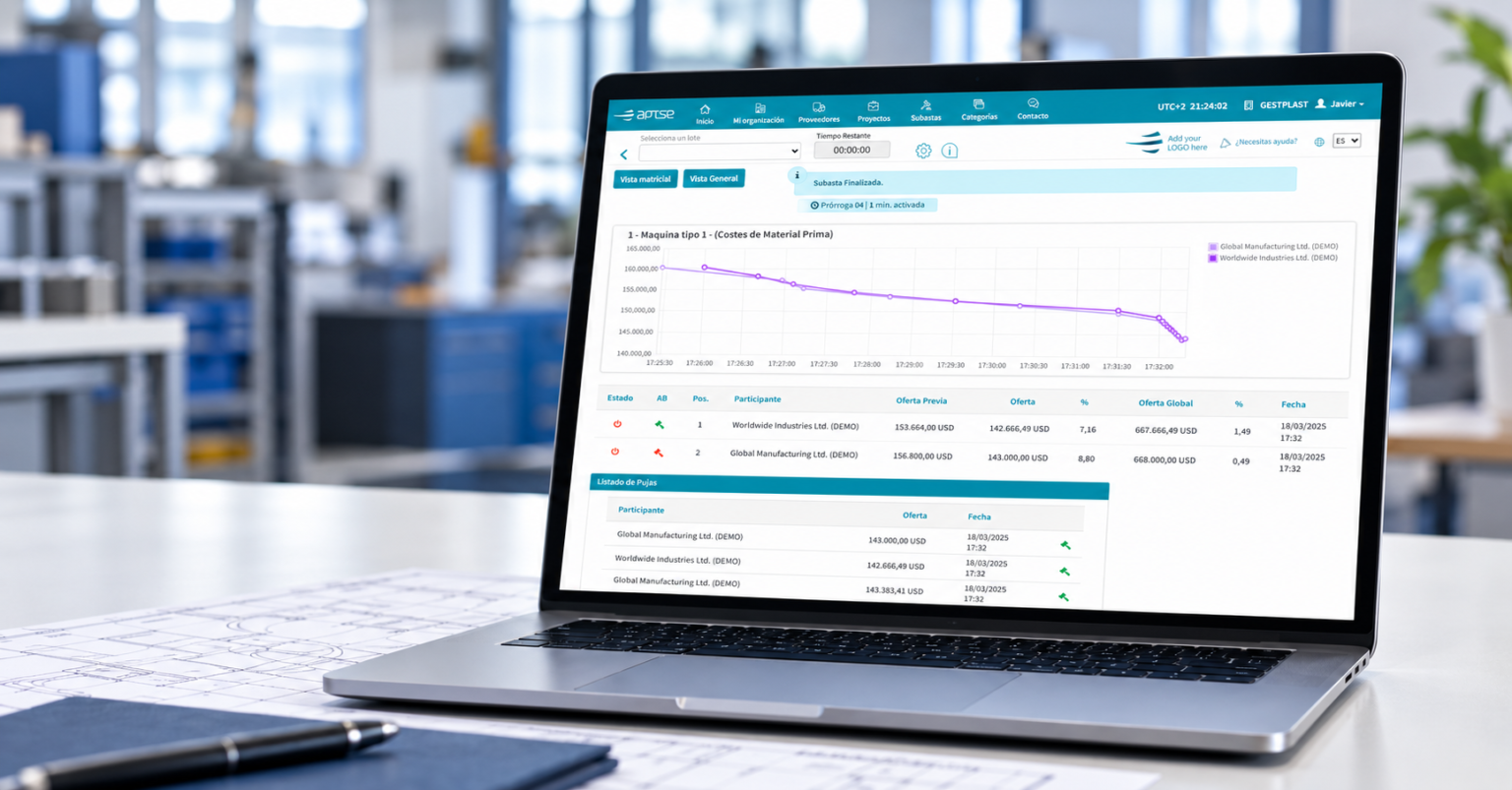
An electronic reverse auction managed by APTSE for sea freight services between France and the United States achieved a 10.86% reduction, with five suppliers participating. The APTSE team prepared, configured and managed the negotiation.
This case, published by Gestplast, illustrates how electronic auctions can support the procurement of international logistics services.
In this type of purchase, price needs to be assessed alongside the service conditions. Understanding what each quotation includes and what each supplier commits to delivering is essential for a meaningful comparison.
The Project: Sea Freight Between France and the United States
The project involved a reverse auction for sea freight services on a route between France and the United States. Five suppliers participated in the negotiation.
| Project detail | Published information |
|---|---|
| Service | Sea freight |
| Route | Between France and the United States |
| Negotiation format | Electronic reverse auction |
| Participating suppliers | 5 |
| Reported reduction | 10.86% |
| APTSE’s role | Auction preparation, configuration and management |
The percentage reflects the result reported for this particular negotiation. It should not be interpreted as an annual saving or as a forecast for other freight contracts.
Why the Service Must Be Defined Before Negotiation
Two freight quotations may have different prices because they cover different services. One might include only the main sea leg, while another includes additional transport or handling operations.
Before requesting quotations, the procurement team should establish a common scope so that suppliers can respond on a comparable basis.
The following points are guidance for preparing future contracts; they are not additional details of the published case:
- Origin and destination: collection and delivery points, including the relevant ports where applicable.
- Cargo characteristics: dimensions, weight and any special handling requirements.
- Expected volume: transport units, shipment frequency and how demand is distributed.
- Service scope: the transport legs and operations included in the request.
- Timing: required dates, frequency and transit-time expectations.
- Rate validity: how long the quoted terms remain valid.
- Additional charges: what is included, what is excluded and which conditions may trigger a price adjustment.
A well-prepared request for quotation, or RFQ, gives suppliers a clear basis for submitting their proposals and helps the buyer identify differences before negotiating.
How to Compare Sea Freight Quotations
Check That the Scope Is Comparable
Each quotation should address the same transport requirement.
Differences in collection or delivery arrangements, shipment frequency or included operations can affect both the price and the suitability of the service. These differences should be clarified before comparing totals.
When a supplier proposes an alternative, the procurement team should assess whether it meets the requirement and record any changes to the comparison.
Identify Additional Charges and Variable Conditions
The main freight rate may not represent the full cost of the service.
The comparison should identify additional charges, the circumstances in which they apply and any conditions that allow the rate to change. A blank field should not be treated as confirmation that a service is included.
Documenting these points helps avoid comparing a complete quotation with one that leaves relevant costs unspecified.
Compare Operational Commitments
The supplier’s ability to deliver the service also matters.
Availability, frequency, transit times, shipment tracking and incident management may all influence the decision. The relevance of each criterion depends on the company’s actual transport needs.
Price should therefore be assessed together with the agreed scope and the supplier’s operational commitments.
The Role of an Electronic Reverse Auction
An electronic reverse auction allows suppliers to compete under defined rules for a purchasing requirement.
Before the auction, the buyer should clarify outstanding questions and establish which suppliers and proposals meet the requirements. This preparation gives the economic negotiation a common basis.
The procurement team should also define how the auction result will be used:
- Which criteria will determine the final selection?
- How will differences between acceptable proposals be assessed?
- Which checks must be completed before the contract is awarded?
The auction supports the negotiation process. Its result must then be assessed against the requirements and translated into a documented agreement.
How to Measure the Result of a Logistics Negotiation
To measure a reduction consistently, the reference used for the comparison should be defined in advance.
For a new project, the procurement team should record:
- The reference price and where it comes from.
- The volume used in the calculation.
- The currency.
- The period covered.
- The services and costs included.
- The terms obtained through the negotiation.
This makes it possible to distinguish a price reduction from a change in volume or service scope.
For contracts involving successive shipments, the negotiated result and the amount ultimately invoiced may differ. Actual expenditure depends on the shipments carried out and the conditions that apply to them.
Tracking both provides a clearer view of the negotiation’s financial impact.
When This Approach May Suit Other Transport Purchases
The suitability of a reverse auction should be assessed for each contract. Three conditions are particularly relevant.
1. A Sufficiently Defined Service
Suppliers need enough information to price the requirement on a common basis.
If the proposals involve substantially different transport solutions, it may be necessary to assess those alternatives before opening the price negotiation.
2. Suppliers Capable of Delivering
Participating suppliers should be able to meet the required coverage, capacity and availability.
A competitive quotation is useful only if the supplier can deliver the agreed service. Checking this capability forms part of effective supplier management.
3. A Result That Can Be Turned into a Clear Agreement
The final agreement should record the negotiated rates, exclusions and service commitments.
This helps the people managing shipments understand which terms apply and provides a basis for checking subsequent invoices and performance.
Organise Your Freight Negotiations with APTSE
APTSE supports digital procurement through its online RFQ software and electronic negotiation tools. Its team can also help prepare, configure and manage electronic auctions.
The sea freight case between France and the United States achieved a reported reduction of 10.86%, with five suppliers participating.
If your company is preparing a transport contract, contact APTSE to discuss your project or request a demonstration.