The main difference between an RFQ and an RFI lies in the purpose of the request and the stage of the purchasing process in which it is used.
An RFI —Request for Information— is used to gather information about suppliers, capabilities and available solutions before a purchase has been fully defined.
An RFQ —Request for Quotation— is used when the company already knows what it needs and wants to request and compare prices and commercial terms.
In simple terms:
- An RFI asks: What suppliers and solutions are available?
- An RFQ asks: At what price and under what conditions can you supply what we need?
Both are part of the RFx family of sourcing processes. They can be used separately or consecutively.
A company may begin with an RFI to understand the market and identify suitable suppliers and then issue an RFQ to the candidates that best meet its requirements.
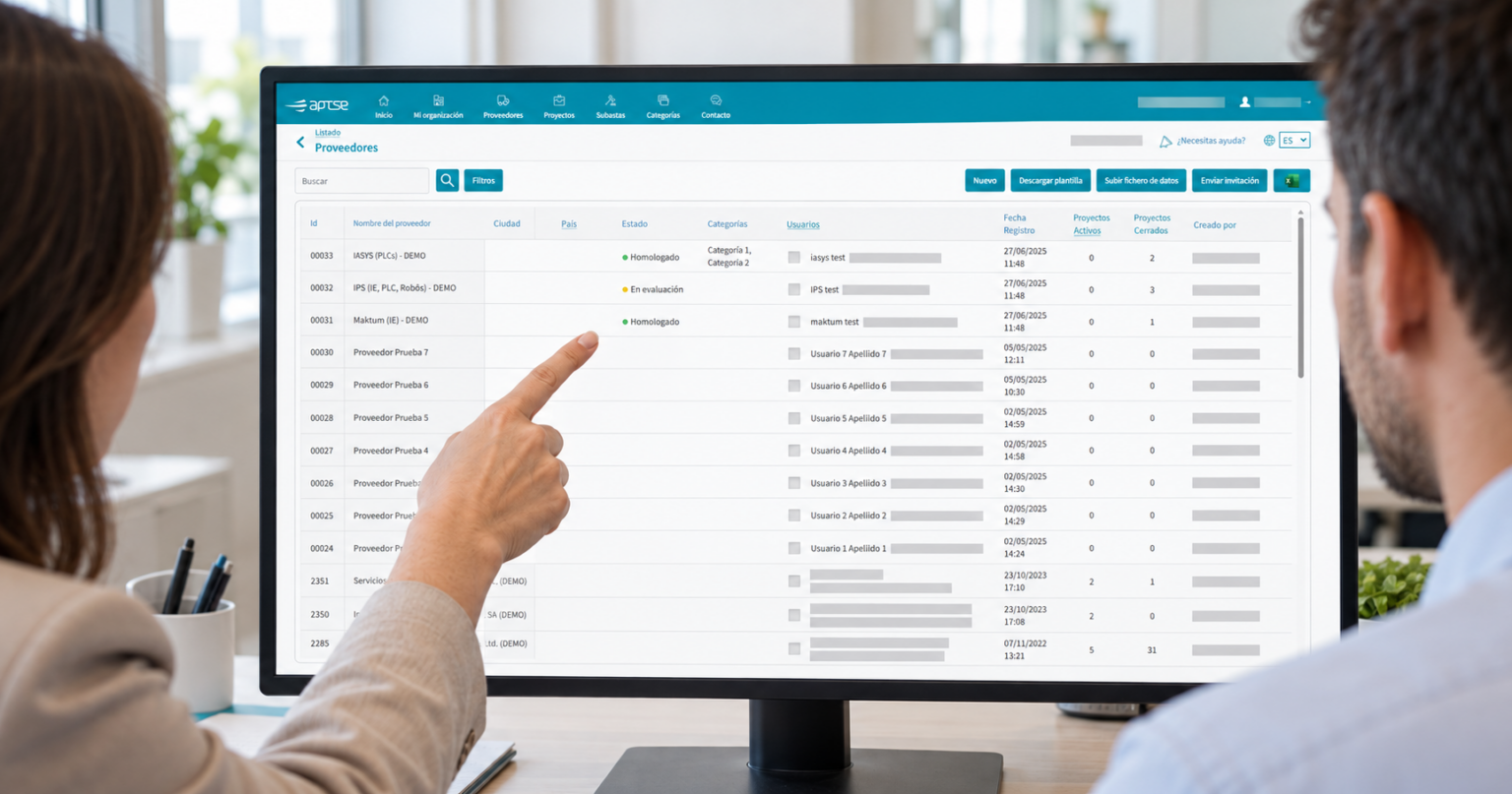
APTSE provides specific tools for gathering and analyzing supplier information through RFIs and for creating, issuing, receiving and comparing quotations through RFQs, all within a single SaaS platform.
What is an RFI?
An RFI, or Request for Information, is a structured request sent by a company to potential suppliers to learn more about their capabilities, experience, products, services or proposed solutions.
It is normally used at an early stage, when the buyer needs more information before defining the final purchasing requirements.
An RFI can help a company:
- Understand the supplier market.
- Identify companies capable of meeting a need.
- Review available technologies and solutions.
- Assess technical or production capabilities.
- Understand suppliers’ geographical coverage.
- Request certifications and references.
- Evaluate experience in similar projects.
- Prepare a future RFQ.
- Update or expand the supplier base.
The main purpose of an RFI is not usually to obtain a final price.
Its purpose is to gather comparable information that helps the purchasing team understand the market, define the requirement more accurately and decide which suppliers should move forward to the next stage.
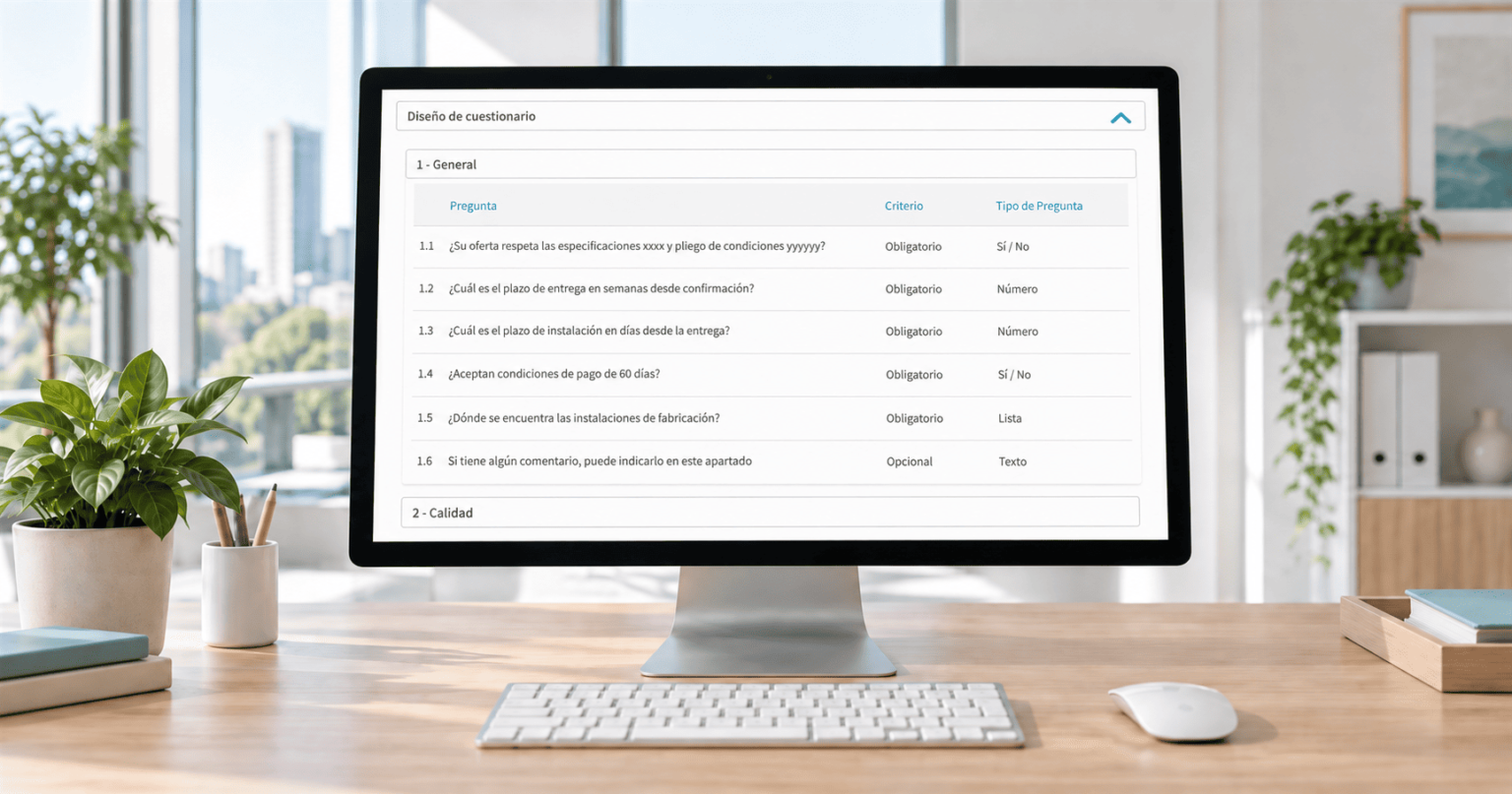
The APTSE RFI module allows companies to create customized questionnaires, define mandatory or optional questions, exchange supporting documents and compare supplier responses in a centralized environment.

Examples of questions included in an RFI
The content will depend on the purchasing category, but an RFI may include questions such as:
- In which countries do you operate production facilities?
- What is your annual production capacity?
- Which quality certifications do you hold?
- Do you have experience in our industry?
- Which technologies do you use?
- Can you support several company locations?
- What are your standard implementation times?
- Do you have your own technical support team?
- Which customer references can you provide?
- What information security measures do you apply?
- Which alternative technical solutions can you offer?
- What documentation would you need to prepare a proposal?
The RFI may also ask suppliers to attach certificates, technical data sheets, presentations, references, reports or any other documentation required for the evaluation.
What is an RFQ?
An RFQ, or Request for Quotation, is a request that a company sends to one or more suppliers to obtain and compare prices and commercial conditions for a particular product or service.
An RFQ is used when the requirement has already been sufficiently defined.
The buyer knows the specifications, quantities, deadlines or key requirements and wants suppliers to respond using a common structure.
An RFQ may request:
- Unit and total prices.
- Volume discounts.
- Transport costs.
- Delivery times.
- Payment terms.
- Quotation validity.
- Warranties.
- Installation costs.
- Maintenance costs.
- Compliance with specifications.
- Additional services.
APTSE defines the RFQ as a request used to obtain different pricing options for a specific product or service, particularly when the company knows exactly what it needs.
The APTSE RFQ software digitizes the process from the initial creation of the request to the final comparison of supplier quotations.
The article “What Is an RFQ? Meaning, Process and Examples” explains this process in greater detail.
Key differences between RFI and RFQ
Although both processes involve communicating with suppliers, they should not be confused.
Each one serves a different purpose.
1. Purpose of the process
An RFI is designed to obtain knowledge and information.
It helps the company understand which suppliers are available, what they can offer, what experience they have and which alternatives exist.
An RFQ is designed to obtain comparable commercial quotations.
It is used to identify the prices and conditions under which several suppliers can fulfil an already defined requirement.
2. Stage of the purchasing cycle
An RFI usually takes place at an early stage, before the specifications have been finalized or the suppliers have been definitively selected.
An RFQ normally takes place later, once the company has enough information to request specific commercial proposals.
A typical sequence may be:
- Identify the business need.
- Conduct an initial market review.
- Issue an RFI.
- Evaluate and shortlist suppliers.
- Finalize the requirements.
- Issue the RFQ.
- Compare quotations.
- Negotiate and award the contract.
Not every purchase needs to follow every stage.
When the company already understands the market and has a group of qualified suppliers, it may begin directly with an RFQ.
3. Level of definition of the requirement
In an RFI, the requirement may still be open.
The company may understand the problem it needs to solve but may not yet know the most suitable technology, scope or solution.
In an RFQ, the requirement must be much more clearly defined.
Suppliers need to understand exactly what they are expected to price so that their quotations can be compared on a common basis.
4. Type of response expected
Responses to an RFI are mainly informational. They may cover the supplier’s capabilities and experience, the technologies it uses, certifications and references, geographical coverage, available resources, alternative solutions or supporting technical documentation.
An RFQ, by contrast, focuses more directly on the commercial proposal. In addition to the price and its possible cost breakdown, the purchasing team may evaluate delivery times and conditions, payment terms, warranties, quotation validity and compliance with the technical requirements.
5. Evaluation method
An RFI is evaluated primarily using criteria related to supplier capability, suitability and experience. Depending on the project, the purchasing team may consider compliance with minimum requirements, industry experience, production capacity, international coverage, certifications, technical resources or the suitability of the proposed solution.
An RFQ is evaluated primarily through the prices and commercial conditions received, although the decision should not be based solely on the lowest quotation. Other relevant factors may include total cost of ownership, quality, delivery time, payment terms, warranties, supply risk, after-sales service and compliance with the requirements.

6. Outcome of the process
The outcome of an RFI is normally a better understanding of the market and a shortlist of potentially suitable suppliers.
The outcome of an RFQ is normally a comparison of commercial quotations that allows the company to:
- Select a supplier.
- Request clarification.
- Open another bidding round.
- Negotiate commercial terms.
- Prepare an electronic auction.
- Award the purchase.
The APTSE RFQ environment allows companies to work with invited suppliers, exchange project documents, compare responses and continue the negotiation through an electronic auction when appropriate.
When should you use an RFI?
An RFI is recommended when the company needs more information before requesting commercial quotations.
When purchasing a new category
When the organization has limited experience in a particular category, an RFI can help it understand the market before establishing requirements that may be too restrictive.
For example, a company considering the implementation of a new technology may use an RFI to identify:
- Types of solutions.
- Specialized suppliers.
- Technical requirements.
- Implementation times.
- Service models.
- Potential limitations.
When the supplier market is unfamiliar
An RFI can help identify and evaluate new sources of supply.
It can be used to expand the supplier base, reduce dependence on a single supplier or identify potential partners in new countries.
When the requirement has not yet been fully defined
In some cases, the company knows the result it wants to achieve but does not yet know how to define the specifications.
Supplier responses may help the company:
- Define the project scope.
- Identify key requirements.
- Compare alternative approaches.
- Detect potential risks.
- Prepare a more accurate RFQ.
When suppliers need to be qualified or shortlisted
An RFI can be used as an initial qualification stage.
The buyer requests corporate, technical, financial or quality-related information and then selects the companies that meet the requirements for participation in the RFQ.
When existing supplier information needs to be updated
Supplier capabilities and circumstances may change over time.
An RFI can also be used to update:
- Certifications.
- Production facilities.
- Geographical coverage.
- Capacity.
- Contact details.
- Available resources.
- Services offered.
When should you use an RFQ?
An RFQ is appropriate when the company can clearly describe what it wants to purchase.
When comparable specifications are available
The products or services must be capable of being priced using common requirements.
Examples include:
- Components manufactured according to a drawing.
- Raw materials with defined specifications.
- Clearly specified industrial equipment.
- Maintenance services with a defined scope.
- Transport services between established routes and locations.
- Supplies with estimated annual consumption.
When prices and commercial conditions need to be compared
An RFQ provides a structured overview of the proposals submitted by different suppliers.
The comparison may include:
- Transport.
- Installation.
- Tooling.
- Maintenance.
- Delivery times.
- Warranties.
- Commercial conditions.
When renewing a contract
Before automatically renewing an agreement, the company may issue an RFQ to determine:
- Whether the existing terms remain competitive.
- Whether alternative suppliers are available.
- Whether the incumbent supplier can improve its proposal.
- Whether market conditions have changed.
When alternative sources of supply are required
An RFQ makes it possible to compare an incumbent supplier with other qualified companies and reduce the risks associated with dependency.
When the quotation will form the basis of a negotiation
The proposals received may be used to:
- Request improvements.
- Negotiate directly.
- Establish a reference price.
- Organize an electronic auction.
- Divide the award among several suppliers.
Can RFI and RFQ processes be combined?
Yes.
Combining both processes can significantly improve the quality of the purchasing decision when the requirement is complex or the supplier market is not sufficiently understood.
Stage 1: identify the requirement
The company defines the problem, objective or purchasing category it wants to evaluate.
At this stage, the final specifications may not yet be available.
Stage 2: issue the RFI
Potential suppliers are invited to answer a structured questionnaire.
The company gathers information about capabilities, technologies, experience and possible solutions.
Stage 3: evaluate and shortlist suppliers
The purchasing team compares the responses and identifies the candidates that meet the requirements.

The information received is also used to improve the definition of the project.
Stage 4: prepare the RFQ
Once the requirement has been clearly defined, the company creates a common template for the shortlisted suppliers to submit their quotations.
Stage 5: compare the proposals
The company evaluates prices, conditions, deadlines and technical compliance.
Stage 6: negotiate and award
After the RFQ, the company may select a quotation directly, request an improvement or continue the negotiation through an electronic auction.
APTSE centralizes RFI processes and the requests for proposals or quotations managed within the RFQ/RFP environment, allowing suppliers, documents, communications and analyses to remain organized throughout the purchasing process.
How does an RFP relate to an RFQ and an RFI?
RFP stands for Request for Proposal.
In general RFx terminology, a distinction may be made between:
- RFI: Request for Information.
- RFP: Request for Proposal.
- RFQ: Request for Quotation.
However, companies do not always use these terms in exactly the same way.
The actual scope depends on the structure of the project and the information requested from suppliers.
Within APTSE, requests for proposals and requests for quotations are managed within the same RFQ/RFx digital environment, while requests designed primarily to collect and analyze supplier information are managed through the RFI module.
APTSE’s English website also presents RFI, RFQ and RFP as processes integrated into a common SaaS ecosystem rather than as three completely separate platform modules.
From a practical APTSE perspective:
- Requests intended to obtain information and evaluate supplier capabilities are managed as RFIs.
- Requests intended to obtain proposals, quotations and commercial conditions are managed within the RFQ/RFP environment.
The key issue is not only the acronym used but also defining clearly what suppliers must provide and how their responses will be evaluated.
Practical example: industrial maintenance services
A company wants to contract maintenance services for several production facilities but does not yet know which suppliers can cover all the locations.
Stage one: RFI
The company first issues an RFI to identify which suppliers are capable of supporting its different production facilities. The questionnaire asks about geographical coverage, the number of available technicians, standard response times, certifications, experience in similar facilities, incident management systems, emergency support and customer references.
After analyzing the responses, the company selects four suppliers with sufficient capability to move forward in the process.
Stage two: RFQ
The company then sends those four suppliers an RFQ defining the facilities covered, the number of inspections, required service levels, operating hours and maximum response times. Using the same basis, each supplier is asked to provide an annual fixed price, rates for additional work, travel costs, payment terms and the proposed contract duration.
The RFI helps the company identify suitable participants and define the service. The RFQ then allows their commercial proposals to be compared on a consistent basis.
Practical example: purchasing industrial machinery
A company wants to automate a manufacturing operation but does not yet know which technologies are available.
RFI to review the available alternatives
The company first uses an RFI to understand the technologies available and compare factors such as production capacity, space requirements, energy consumption, installation requirements, maintenance needs, supplier experience and indicative lead times.
Using this information, the company can identify the most suitable solution and prepare more precise specifications.
RFQ to compare quotations
Once the solution has been defined, the shortlisted suppliers receive an RFQ asking them to quote on the same basis for the machine, transport, installation and commissioning, training, warranty, maintenance, spare parts and manufacturing lead time.
This approach prevents the company from requesting prices for fundamentally different solutions and produces quotations that can be compared more reliably.
Common mistakes when choosing between an RFI and an RFQ
Issuing an RFQ before defining the requirement
When the specifications remain open, each supplier may price a different solution.
The resulting quotations will be difficult to compare.
Turning the RFI into a disguised RFQ
An RFI should not request a firm final price when the supplier does not yet have enough information to calculate it accurately.
Indicative pricing may be requested, but the purpose of the process should be made clear.
Creating unnecessarily long questionnaires
Requesting irrelevant information increases the workload for suppliers and makes the responses more difficult to evaluate.
Every question should serve a genuine evaluation purpose.
Inviting unqualified suppliers to an RFQ
When the company does not know the participants well enough, an RFI or a preliminary evaluation may be required first.
Allowing suppliers to respond in different formats
When every supplier uses its own spreadsheet or document, the comparison becomes more time-consuming and the risk of misinterpreting information increases.
Failing to use the results of the RFI
The information collected should help the company define the RFQ, shortlist suppliers or adjust the purchasing strategy.
An RFI that does not lead to any subsequent decision becomes an administrative burden for both the buyer and the suppliers.
Manage your RFQs and RFIs from a single platform
Managing supplier requests through separate emails and spreadsheets can become increasingly difficult as the number of suppliers, users, questions, documents and quotations grows.
APTSE allows companies to centralize both processes within the same environment. During an RFI, purchasing teams can create structured questionnaires with mandatory or optional questions, share supporting documentation and compare the responses received. During an RFQ, they can create cost-breakdown templates, invite selected suppliers and analyze their quotations using a common structure.
The platform also centralizes communications, makes it possible to monitor supplier participation, maintains an activity history and supports the import and export of information through Excel. When the purchasing strategy requires further competitive negotiation, the process can continue through an electronic auction.
APTSE therefore provides a common SaaS environment for managing supplier information, quotations, documents, communications and subsequent negotiations.
Choose the right process for each purchase
An RFI and an RFQ do not compete with each other.
They serve different purposes and, in many projects, they are complementary.
Use an RFI when you need to understand the market, assess supplier capabilities or define the purchasing requirement more accurately.
Use an RFQ when the requirement has already been defined and you want to receive comparable commercial quotations.
With APTSE, you can manage both stages from a single platform, retain all the project information and move from supplier evaluation to quotation comparison and final negotiation.
Request a personalized demonstration or try APTSE free for seven days.
Frequently asked questions about RFQ and RFI
What is the main difference between an RFQ and an RFI?
An RFI is used to gather information about suppliers, capabilities and solutions.
An RFQ is used to request and compare prices and commercial conditions once the requirement has been clearly defined.
Does an RFI always need to be completed before an RFQ?
No.
An RFI is only required when the company needs to understand the market, assess suppliers or define the requirements.
When this information is already available, the company can begin directly with an RFQ.
Can an RFI be used to select the final supplier?
An RFI is normally used to gather information and shortlist potential suppliers.
The final selection or award usually takes place after an RFQ, negotiation or subsequent sourcing process.
What does RFx mean?
RFx is a general term covering different types of requests sent to suppliers, including RFI, RFQ and RFP.
The “x” represents the information, proposal, quotation or other response being requested.
Are RFP and RFQ the same?
General procurement terminology may distinguish between an RFP, which asks for a proposal, and an RFQ, which asks for a quotation.
Within APTSE, requests for proposals and quotations are managed within the same RFQ/RFx environment, while information requests are handled through the specific RFI module.
Which process should be used to compare prices?
An RFQ is the process used to request and compare prices and commercial conditions from different suppliers.
Can an RFQ lead to an electronic auction?
Yes.
When the quotations are comparable and there is sufficient competition, an RFQ can be used as the preliminary stage for setting the conditions and preparing an electronic auction.
APTSE’s auction module allows invited suppliers to participate in a private and controlled negotiation environment.