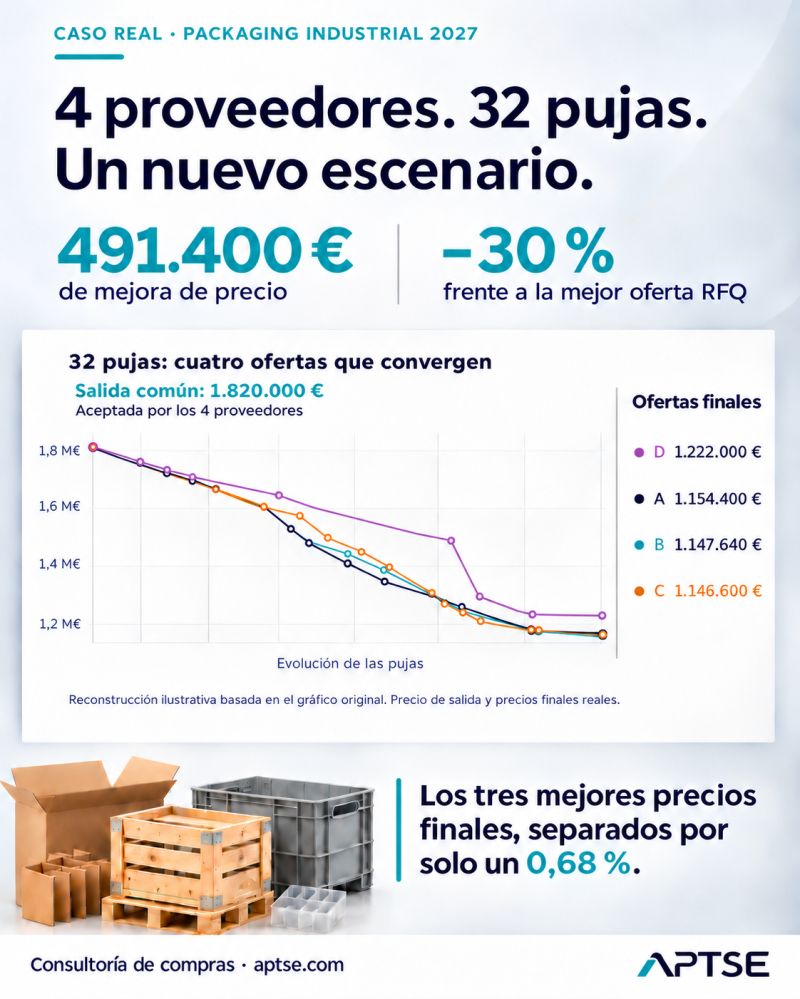
A packaging reverse auction for 2027, managed for an industrial client, achieved a €491,400 price reduction: 30% compared with the best quotation received in the RFQ. Four suppliers participated and submitted 32 bids. The supplier with the lowest initial price did not finish first.
The result also shows how a negotiation can change when suppliers revise their proposals in a competitive environment. The three lowest final prices were just €7,800 apart, although that narrow gap does not replace an assessment of quality, service and capacity.
The Starting Point: Four Quotations for 2027 Packaging
The RFQ brought together four proposals for an industrial client’s packaging requirements. Initial quotations ranged from €1,638,000 to €1,950,000, leaving a €312,000 gap between the lowest and highest.
Multiple quotations reveal suppliers’ starting positions, but the initial ranking does not necessarily predict the negotiation outcome. In this project, supplier C ranked third before the auction and finished with the lowest price.
Preparing a negotiation requires a common basis for comparison. Before suppliers compete on price, the team should review scope, quantities, technical requirements and supply conditions. Our guide to preparing an electronic auction explains what to validate before starting.
Results of the Packaging Reverse Auction
After 32 bids, the lowest final quotation was €1,146,600. The improvement is measured against the best RFQ quotation of €1,638,000, rather than the auction’s starting price.
| Measure | Result |
|---|---|
| Participating suppliers | 4 |
| Bids submitted | 32 |
| Best RFQ quotation | €1,638,000 |
| Lowest final quotation | €1,146,600 |
| Price reduction | €491,400 |
| Improvement against the best RFQ quotation | 30% |
The calculation is straightforward: €1,638,000 − €1,146,600 = €491,400. Dividing that reduction by the best RFQ quotation gives 30%.
The project chart shows a common starting price of €1,820,000, accepted by all four suppliers. This figure relates to how the auction was run; the benchmark used to report the improvement remains the best RFQ quotation. Keeping the two figures separate avoids overstating the result.
Supplier C Moved from Third Place to the Lowest Price
The final price ranking was as follows:
| Price ranking | Supplier | Final quotation |
|---|---|---|
| 1 | C | €1,146,600 |
| 2 | B | €1,147,640 |
| 3 | A | €1,154,400 |
| 4 | D | €1,222,000 |
Supplier B finished €1,040 above the lowest price. Supplier A was €7,800 above it. The three leading quotations therefore fell within a band of approximately 0.68% of the lowest final price.
This change shows why a negotiation should not be treated as settled on the strength of initial quotations alone. In this case, competition changed both prices and suppliers’ positions.
What Does Price Convergence Mean?
The gap between the highest and lowest price narrowed from €312,000 at the RFQ stage to €75,400 at the end of the auction. Quotations became closer, allowing the procurement team to assess alternatives with smaller price differences.
However, similar prices do not make two solutions equivalent. Supplier selection must also consider:
- Quality: whether the packaging meets the defined requirements.
- Capacity: whether the supplier can deliver the required quantities to the planned schedule.
- Service: delivery arrangements, responsiveness and communication.
- Compliance: acceptance of the agreed scope and conditions.
The price ranking should be considered alongside the technical and service assessment to support supplier selection. In this case, the confirmed outcome is that supplier C submitted the lowest final price.
What Procurement Teams Can Learn from This Case
Define the Benchmark Before Measuring Improvement
A reduction is meaningful only when its comparison basis is clear. Here, the benchmark is the best RFQ quotation of €1,638,000. Reports should apply that basis consistently and distinguish it from other figures, such as the common starting price.
Review Proposals Before Negotiating
Differences in scope or missing information may require RFQ rounds to clarify and review quotations. Negotiation is more useful when the team understands what each proposal includes.
Assess the Full Set of Alternatives
As well as identifying the lowest price, it is useful to examine its distance from the alternatives. In this auction, three suppliers finished within a €7,800 band. That information helps put technical and service criteria into context.
Choose the Negotiation Format Carefully
The format and rules should reflect the characteristics of the procurement process. Our comparison of English and Dutch reverse auctions explores this choice. The 32 bids in this case document its competitive activity; they are not a required number for achieving results in other projects.
Consulting and Technology for Your Next Procurement Project
At APTSE, we combine procurement consulting and our own technology to prepare and manage negotiations. This packaging project demonstrates a specific outcome: a 30% price improvement and a final ranking that differed from the initial one.
This is a negotiation result, rather than a guarantee for future purchases or confirmation of savings realised during supply delivery. Each process depends on its conditions, suppliers and preparation.
If you are preparing your 2027 procurement projects, explore APTSE and request a demonstration to discuss how to organise your RFQ, compare proposals and prepare your negotiation.